
Copyright Notification
Prof Bhatia Copyright Notification may be read below
COPYRIGHT NOTIFICATION - FOOT & ANKLE LEICESTER
It is crucial to respect copyright and the protection it provides to creators and authors of original works. Copyright laws are designed to safeguard creators’ intellectual property, intellectual labour, and the rights associated with their creations. This ensures that those who create can benefit from their efforts, and that their work is not used without permission, improperly distributed, or copied.
If you encounter copyrighted information, honouring these legal provisions is essential. It not only respects the creator’s legal rights but also fosters an environment of innovation and creativity where authors, such as Prof Bhatia, feel secure to share their knowledge and advancements. Observance of copyright protects the integrity of content and contributes to the ongoing progression of a wide range of industries and disciplines.
Prof Bhatia has spent much time putting the information below together and to help his patients through their journey with his services and would ask that you respect this by not copying or distributing this content.
Read More here Copyright laws & on Wikiperdia https://en.wikipedia.org/wiki/Copyright
Information leaflets & educational videos
Introduction
The following are the information leaflets aimed at giving you an insight regarding common foot and ankle conditions, treatment and recovery after operation. Please click on the relevant condition to access the information.
Achilles Tendonitis
 Achilles Tendonitis PDF Download – The Achilles tendon is the largest tendon in the body and can withstand enormous forces. Unfortunately, it has a poor blood supply which predisposes it to problems. Inflammation and swelling of this tendon is known as Achilles tendonitis which is a common problem due to overuse. The other terms used for the se disorder include Achilles tendinosis or tendinopathy. – Download PDF for further information.
Ankle Arthroscopy
Ankle Arthroscopy PDF Download – It is the minimally invasive ankle surgery of ankle. Ankle arthroscopy involves using very small incisions to gain access into the ankle joint. Each incision is less than 1cm and usually two incisions are required. The ankle joint is relatively small and to allow good surgical access to the joint, its dimensions need temporarily to be increased. This is done using a combination of distraction across the joint together with having a stream of pressurized fluid circulating through the joint which distends it. The inside of the ankle joint can be inspected using a small camera with operations carried out on the joint using small, specially designed instruments. – Download PDF for further information.
Ankle Fusion
Ankle Fusion PDF Download – What is ankle arthritis? – Arthritis is a condition where a joint looses its protective layer (cartilage). As a result the bone surfaces rub each other which cause pain. Arthritis of ankle joint is usually due to previous injury or rheumatoid arthritis. – Download PDF for further information.
Ankle Replacement
Ankle Replacement PDF Download – What is an ankle replacement? An ankle replacement is an operation like hip or knee replacement in which the diseased joint cartilage is replaced by metallic surface on both sides with special plastic (polyethylene) in middle. It is designed to preserve the movements of the ankle joint. – Download PDF for further information.
Big Toe Arthritis
Big Toe Arthritis PDF Download – Arthritis of big toe (Hallux Rigidus) – What is Hallux Rigidus? – The big toe is most common site of arthritis in the foot. The joint affected is called the metatarsophalangeal or MTP joint. If the joint starts to stiffen due to arthritis, walking can become painful and difficult. In the MTP joint, as in any joint, the ends of the bones are covered by a smooth articular cartilage. If wear-and-tear or injury damages the articular cartilage, the raw bone ends can rub together. A bone spur or overgrowth may develop on the top of the bone (As shown in the picture below). This overgrowth can prevent the toe from bending as much as it needs to when you walk. The result is a stiff big toe or hallux rigidus. – Download PDF for further information.
Bunion
Bunion PDF Download – What is a Bunion? – Bunion is the prominent bony swelling of the big toe. This develops as the ‘metatarsal’ bone of the big toe starts pointing towards the inner border of the foot forming the bunion. Gradually the big toe itself drifts towards the second toe. – Download PDF for further information.
Living with and getting rid of bunions – Bunions can be painful and their appearance embarrassing. Occasionally bunions can lead to more serious problems. Here’s how to live with, and when to get rid of, your bunions. Download PDF for further information.
Cartiva Implant for arthritis of big toe
Cartiva Implant for arthritis of big toe patient leaflet download – Cartiva is a synthetic cartilage plug (polyvinyl alcohol hydrogel), which is comprised of material with properties similar to those of native cartilage. It is softer than metal and has similar strength that of human cartilage. It works as a spacer in the joint thereby separating the joint surfaces and therefore improves the pain and preserves movements. The patient leaflet covers –
- What is Hallux Rigidus?
- What is the treatment?
- Is there any alternative treatment to avoid Joint Fusion?
- What are the advantages of Cartiva?
- What are the disadvantages?
- Is there any scientific evidence?
- What can be done if Cartiva fails?
- What does the surgery involve?
- What is the recovery following Cartiva?
- What are the surgical risks?
Download the patient leaflet for further information, or click on the You Tube icon to see a short video of the surgery.
Ingrowing toe nail
Ingrowing toe nail PDF Download – What is an ingrowing toenail? – If you trim your toenails too short, particularly on the sides of your big toes, you may set the stage for an ingrowing toenail. Like many people, when you trim your toenails, you may taper the corners so that the nail curves with the shape of your toe. But this technique may encourage your toenail to grow into the skin of your toe. The sides of the nail curl down and dig into your skin. An ingrowing toenail may also happen if you wear shoes that are too tight or too short. – Download PDF for further information.
Morton’s Neuroma
Morton’s Neuroma PDF Download – What is Morton’s Neuroma? – A Neuroma is a benign tumour of a nerve. Morton’s Neuroma is not actually a tumour but a thickening of the tissue that surrounds the digital nerve between the toes. Morton’s Neuroma occurs as the nerve passes under the ligament connecting the toe bones (metatarsals) in the foot. Morton’s Neuroma most frequently develops between the third and fourth toes usually in response to irritation, trauma or excessive pressure. It can also develop between second and third toes. It usually affects females though males can develop this condition as well. – Download PDF for further information, or click on the You Tube icon to see a short video of the surgery.
Patient Information Leaflet for Joint Injections
Patient Information Leaflet for Joint Injections – PDF Download – Steroid injections are commonly performed for joint or soft tissue related pain. This leaflet attempts to answer questions commonly asked by patients about steroid injections.
Plantar Fasciitis
Plantar Fasciitis PDF Download – What is plantar fasciitis? – The plantar fascia is a strong band of tissue that stretches from the heel to the toes. It supports the arch of the foot and also acts as a shock-absorber in the foot. Repetitive small injuries to the fascia is thought to be the cause of plantar fasciitis. Plantar fasciitis means inflammation of the plantar fascia. The injury is usually near to where the plantar fascia attaches to the heel bone. – Download PDF for further information.
Shock wave Therapy
Shock wave Therapy PDF Download – Extracorporeal shock wave therapy, or ESWT, has emerged as a possible treatment option for patients with chronic plantar fasciitis. ESWT delivers focused shock waves to the area of application. Shock wave therapy is thought to work by inducing micro trauma to the tissue that is affected by plantar fasciitis. This micro trauma initiates a healing response by the body. This healing response causes blood vessel formation and increased delivery of nutrients to the affected area. The micro trauma is thought to stimulate a repair process and relieve the symptoms of plantar fasciitis. – Download PDF for further information.
Tibialis Poterior Tendon Disorders
Tibialis Poterior Tendon Disorders – PDF Download – Tibialis Posterior Tendon Dysfunction Tendons connect muscles to bones. One of the most important tendons in the leg is the Tibialis Posterior tendon. This tendon starts in the calf, stretches down behind the inside of the ankle and attaches to bones in the middle of the foot. It helps hold your arch up and provides support as you step off on your toes when walking. If this tendon becomes inflamed, over-stretched or torn, you may experience pain on the inner ankle and gradually lose the inner arch on the bottom of your foot, leading to flatfoot. – Download PDF for further information.
Anaesthesia For Your Operation
Introduction
The following information will help you to get an insight in the anaesthesia for your operation.
Anaesthesia for your operation
Anaesthesia (UK) – Local and General anaesthesia information PDF Download – A general anaesthetic produces a state of controlled unconsciousness during which you feel nothing. You will receive: ● anaesthetic drugs (an injection or a gas to breathe); ● strong pain relief drugs (morphine or something similar); ● oxygen to breathe; ● sometimes, a drug to relax your muscles. You will need a breathing tube in your throat whilst you are anaesthetised to make sure that oxygen and anaesthetic gases can move easily into your lungs. If you have been given drugs that relax your muscles, you will not be able to breathe for yourself and a breathing machine (ventilator) will be used. When the operation is finished the anaesthetic is stopped and you regain consciousness. – Download PDF for further information.
Physiotherapists
Introduction
This is the current protocol used by Mr Bhatia for Post operative physiotherapy and is aimed at helping the physiotherapist who is looking after the patients after operation. Please contact Mr Bhatia directly if there is any doubt.
Ankle Arthroscopy (Cheilectomy

Ankle Arthroscopy (Cheilectomy)
Post Op
- Mobilise as pain allows to FWB
- Active ankle dorsiflexion
2 weeks Post Op
- Active & Passive ankle ROM exercises
- Gait re-education
- Balance and proprioreception work
Ankle Joint Replacement
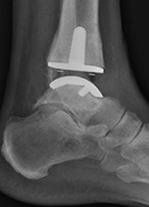 Ankle Joint Replacement
First 6 weeks
- Mobilise NWB in cast
6 weeks Post Op
- Mobilise FWB
- Active ROM exercises as able
- Gait re-education
- Balance and proprioreception work
Ankle Ligament Reconstruction
 Ankle Ligament Reconstruction
Post Op
- Mobilise NWB 6 weeks
- Boot FWB
- Gentle active range of movements ankle (Plantarflexion, Dorsiflexion, Eversion)
- Scar and swelling management
- Stationary bike
- Core exercises
- Hip and Knee stretching and strengthening
Bunion Surgery (Scarf Osteotomy)
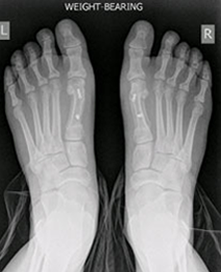 Bunion Surgery (Scarf Osteotomy)
- Mobilise in heel weight bearing shoe (Darco) for 6 weeks
- (Try not to remove the Shoe)
- Active and passive ROM 1st toe
- (Try not to remove the Shoe)
- FWB mobilisation (Remove Darco Shoe)
- Active and passive ROM 1st toe
- Gait re-education,
- Balance and proprioreception
Cheilectomy
Cheilectomy
- Mobilise FWB
- Active ankle exercises and ROM
- Active and passive toe ROM exercises especially great toe MPJ
- Increased physio input if patient unable to mobilise MPJ effectively
- Continue with ROM exercises
- Strengthening work
- Gait re-education
- Balance and proprioreception work
Triple Arthrodesis, Talonavicular Arthrodesis and Subtalar Arthrodesis
Triple Arthrodesis, Talonavicular Arthrodesis and Subtalar Arthrodesis
- Mobilise NWB in cast
- Mobilise Partial weight bearing in cast
- Mobilise FWB in boot
- Active mobilisation of Ankle and toes
- Boot to be removed
- Gait re-education
- Balance and proprioreception work
Tibialis Posterior Reconstruction (with Os Calcis Osteotomy)
 Tibialis Posterior Reconstruction (with Os Calcis Osteotomy)
- Mobilise NWB in cast
- Mobilise FWB in Boot
- Active ROM exercises
- Inversion strengthening exercises (Avoid Eversion)
- General foot and ankle strengthening
- Remove Boot
- Start Eversion
- Gait re-education
- Balance and proprioreception work
Clinical examination of Foot and Ankle
Clinical Examination of Foot and Ankle
Clinical Examination of Foot and Ankle – Click on the You Tube image to hear about a clinical examination of Foot and Ankle by Maneesh Bhatia, Consultant Orthapaedic Foot and Ankle Surgery, Leicester, UK – Further details and information can also be found in the following book: https://www.crcpress.com/An-Orthopaedics-Guide-for-Todays-GP/Bhatia-Jennings/p/book/9781785231261
Road To Recovery by Tobi Adebayo-Rowling
An insight to the road to recovery by a footballer following ankle ligament surgery
Rosemary Conley CBE interviews Mr Maneesh Bhatia
Rosemary Conley CBE is one of the UKs most successful diet and fitness experts with 50 years experience in helping people to lose weight and get fitter.
Rosemary asks Consultant Orthopaedic Surgeon Mr Maneesh Bhatia the facts about what type of exercise is best if we suffer from arthritis. Maneesh also explains the importance of stretching before and after we exercise, particularly if we suffer from plantar fasciitis.
Introducing Mr Maneesh Bhatia
These videos are best viewed on Vimeo. However, you may also watch them on this website. Performance issues may be encountered, depending on your internet connection
Introducing Mr Maneesh Bhatia Vimeo link 1: https://vimeo.com/547088104
MR MANEESH BHATIA EXPLAINS ARTHRITIS Vimeo Link 2: https://vimeo.com/547053622
MR MANEESH BHATIA – ALL ABOUT SURGERY Vimeo Link 3: https://vimeo.com/547052452
MR MANEESH BHATIA – ARTHRITIS AND EXERCISE Vimeo Link 4: https://vimeo.com/547051363
MR MANEESH BHATIA – OVERWEIGHT AND FEET Vimeo link 5: https://vimeo.com/548812807
The Vimeo videos on the Foot & Ankle website have been reduce to 360p in size to aid with performance on your device. 720p viewing is available on Vimeo
MR MANEESH BHATIA EXPLAINS ARTHRITIS
MR MANEESH BHATIA – ALL ABOUT SURGERY
MR MANEESH BHATIA – ARTHRITIS AND EXERCISE
MR MANEESH BHATIA – OVERWEIGHT AND FEET